Cole-Hamilton discusses his new approach to politics at Scotland 2050
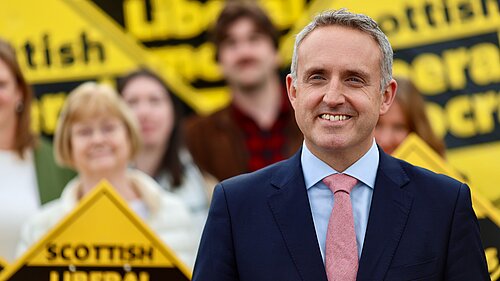
Scottish Liberal Democrat leader Alex Cole-Hamilton MSP has used a keynote speech to highlight what he has learned in his time as an MSP and how his party intends to use their stronger influence in this parliament to provide effective opposition that will get things done for people.
At the Scotland 2050 conference, Alex reflected on how he has changed as an MSP, and how landmark events, including the war in Ukraine, have helped to shape his approach to politics.
As he discussed what strong political opposition should mean, the Scottish Liberal Democrat leader spelled out how his party will use their new influence in this parliament to get things done for people across the country.
Addressing the conference, Alex said:
“Scottish Liberal Democrats are in great heart.
“Last month’s elections were the best results for us in twenty years. We came second in the constituencies. We took a huge leap forward in terms of votes and seats. We won in places we’ve never won before.
“And, as The Times said, “In the final analysis it was the Lib Dems who perhaps did more than any other party to thwart the nationalist march to 65 seats.”
“I’m so excited about the talent in our new group. Just go and look at Duncan Dunlop’s first speech last week. He’s a world-renowned expert on care experienced young people.
“You could hear a pin drop in Parliament when he used that speech to demand that the government take an interest when care experienced young people die prematurely. In his words, “what parent doesn’t know if their children are alive?”
“He read out the names of some of the children of the state who have died in recent years. Children of Scottish ministers by law, and to whom a promise was made, but not kept.
“He spoke with purpose, conviction, knowledge. Go watch it. Mark my words, Duncan and the others in our new group are going to shake things up.
“And as we now unquestionably hold the balance of power, I want to talk about how we will use that new influence.
“I remember those early days - akin to the first days of school.
“But I’m not the same person, the same MSP, that I was 10 years ago. Things have happened in my personal life, in my political life, over the last decade that have changed the way I approach things.
“They have shaped my politics, who I am, and my aspirations for my party.
“Take Ukraine. Paul Sweeney and I drove ambulances across Europe to the armed forces of Ukraine last year. It’s just three tanks of diesel away.
“The mayor of Lviv has got potholes to fill and bins to collect, just like any other city leader, but he also told us that 20% of his city’s budget is automatically diverted to frontline weaponry. Every morning he presides over funerals.
“The picturesque park in the centre of his city, not unlike Princess Street Gardens, has been converted into a cemetery for the war dead. New graves, everywhere. They call it the Field of Mars.
“Then there was Father Taras, an army chaplain on the Eastern Front. He never carries a gun. In his eyes, the tension between his godly world view and love of Christ, and the violence that he sees and has to condone. “I don’t get a lot of people coming to my services”, he told me. “The men really just want me to hear their confession, because they think that they’re going to die.”
“A couple of days after we delivered those ambulances to Ukrainian commanders at Yavoriv military training centre, a Russian double agent was arrested. He had orders to assassinate them all.
“It’s experiences like this that have made me take myself more seriously.
“Because I bounded into Parliament 10 years ago. But I look back at some of the scrapes I had, at some of the twitter spats I got into with random cybernats, and frankly, I wince.
“But for too many in Parliament, and in wider Scottish politics, that’s still the game. It’s their bread and butter.
“Jumping on every bandwagon.
“Picking fights for the sake of it.
“Sending out angry press releases.
“Without ever getting anything done.
“Scotland deserves better than that.
“But what is strong opposition?
“When John Swinney became First Minister and wanted to make Kate Forbes his Deputy, other parties just expected us to go along with them and oppose her appointment.
“After Humza Yousaf’s departure, the collapse of the Bute House Agreement, they wanted to give the government another bloody nose and blocking Kate was the next opportunity.
“They wanted to layer chaos on chaos, thinking that’s what opposition is about. To cause as much trouble for the government as possible. It’s not. That’s not strong opposition.
“While Kate and I are vigorously opposed on various issues, around conscience and constitution, we still thought Kate deserved a chance to serve in government again, and we thought the government might perform better if she did.
“Because strong opposition isn’t jumping on every bandwagon.
“It isn’t picking fights for the sake of it, sending out angry press releases.
“I think strong opposition is intelligent, measured criticism and scrutiny. At times, thoughtful cooperation, where we can find common ground.
“That’s how you get things done.
“Scotland has been poorly served by this SNP Government. Of that, there is no doubt. But it’s been poorly served by the big opposition parties too.
“Now, people are taking my party more seriously. That comes with a responsibility on us to use our bigger influence, and our strength, with care. The government doesn’t hold all the cards.
“I go back to what the Times said - that it was the Liberal Democrats that stopped an SNP majority.
“But they should have never have been anywhere near a majority. They got 38% of the constituency vote and 27% on the list vote. The SNP went backwards.
“Pro-independence parties gamed the system to get an unrepresentative majority of seats on around 40% of the vote combined.
“That this is possible, fundamentally demonstrates the flaws in our electoral system.
“We need voting reform in both of our parliaments.
“Last weekend, the challengers to the Labour leadership were sending signals about proportional representation. But we’ve seen it before.
“Parties, prospective prime ministers, they say one thing in opposition or out of office, because it is politically convenient in that moment.
“And then they decide once they are in power that winning two thirds of the seats, with only one third of the vote, is actually quite convenient in that moment.
“I stand here as someone who a few weeks ago secured 23,000 votes in Edinburgh North Western – the highest number of votes received by any candidate at this election, for the second election in a row. First Past The Post, in this moment, is quite convenient for me. But this isn’t about me.
“I still believe that our country would be better served if there was a fairer voting system.
“For a hundred years, Liberals and Liberal Democrats have fought for fair votes.
“We introduced STV for Scotland’s council elections.
“It means the percentage of votes you get equates much more closely to the number of seats you receive.
“At Holyrood, it would force parties to work together more, to find compromises, to hunt for agreement. A fairer voting system would be foundational for both the make-up and tone of the Parliament. It would help tackle the politics of extremes.
“If people believed that their vote would better shape their Parliament, it would help to restore trust in politics.
“I knock more doors than any other leader. Everywhere I go, people are saying the same things. Trust in politics has never been lower.
“We are amidst the noise of one of the most astonishing scandals of the devolution era, following Peter Murrell’s admission of guilt.
“This isn’t going away. John Swinney is wrong to try and block a parliamentary inquiry.
"I’ve been struck by how many people have come up to me in the last few days, unsatisfied by what they’ve been told, wanting answers.
“Big important questions still remain.
“Why was an SNP source quoted in the Daily Record the very week the campervan was seized, passing it off as a legitimate SNP asset for a covid election? Who told them to say that?
“Why are SNP backbenchers still happy to just sit quietly and not ask questions? I can’t imagine my party would be as pliant.
“And if the SNP leadership can’t be trusted with stewarding the finances of the SNP, why should we trust them with stewarding the finances of the country?
“Sunlight is the best disinfectant. We need that inquiry now.
“But we need to go further than that to clean up our politics.
“Westminster has had recall for 10 years now. It’s removed the likes of Margaret Ferrier, who – with covid - travelled on trains down and back from London in 2020, even made a speech in the Commons, knowingly risking others’ lives.
“But meanwhile, Holyrood has no equivalent measure. It’s why people like Derek Mackay were able to take their wage and never show up.
“It’s why Michael Matheson couldn’t be sacked by his constituents over the iPad scandal, even after being banned from Parliament for a record 27 sitting days.
“I still can’t fathom why the SNP and Greens blocked the introduction of recall in February. It’s long overdue.
“Recall provides a solution for when things go wrong, but we need to provide some level of reassurance that the right people are in politics in the first place.
“As a former youth worker, I’ve proposed changing the law so that elected representatives join the hundreds of thousands of professionals and volunteers who are already subject to safeguarding legislation.
“Parents should know that young people on work experience are with someone who can be trusted. Carers should know that vulnerable adults attending a casework surgery aren’t going to be left alone with someone who hasn’t undergone any independent vetting whatsoever. It can't be one rule for politicians and another for everyone else.
“There need to be measures that protect against people working in politics using their status to manipulate, target and exploit vulnerable people.
“Now is the time to close the loopholes.
“To end the culture of secrecy and spin.
“To put more power in people’s hands.
“So that politics is made to work for you again.
“When people don’t feel their vote will count, when they can’t trust the politicians they are electing, they either don’t turn out or they are driven towards extremes.
“Remember, turnout at this election dropped 10%.
“Without proper accountability, when nobody resigns over scandals like the ferries fiasco, the deletion of covid WhatsApps, the deaths at the Queen Elizabeth University Hospital, how can we blame people for just turning away.
“While the public feels like there’s nothing worth voting for, we aren’t going to get better public services.
“That’s why events like this are so important. They offer an opportunity to imagine a different kind of politics. Where there’s more power in people’s hands. Where we reflect the better natures of the people who send us to Parliament. And where we work with a unified intent towards a better Scotland.
“Thank you.”