Who we are
The Scottish Liberal Democrats were formed on 3 March 1988 from the merger of the Scottish Liberal Party and the Social Democratic Party in Scotland. We are a State Party of the Liberal Democrats, a federal political party that organises across Great Britain.
As founding members of Liberal International, we work with our friends across the world; including the Alliance Party in Northern Ireland, the Liberal Party of Canada, the Democratic Alliance of South Africa and the Alliance of Liberals and Democrats for Europe.
We are a democratic party. Our members elect our leaders and office-bearers, choose our candidates, write and approve our polices and campaign to build and safeguard a fair, free and open society here in Scotland.
Origins - Who were The Liberal Party?
The Liberal Party was founded in June 1859 through a merging of the Whigs (dating from the first half of the eighteenth century), the Radicals and the Peelites. From 1859 until the First World War the Liberals dominated Scottish politics. Scottish Liberals were a broad group, encompassing businessmen and artisans in urban areas with Whig aristocrats in the Borders and land reformers in the Highlands- all united around Gladstone’s programme of Peace, Retrenchment and Reform.
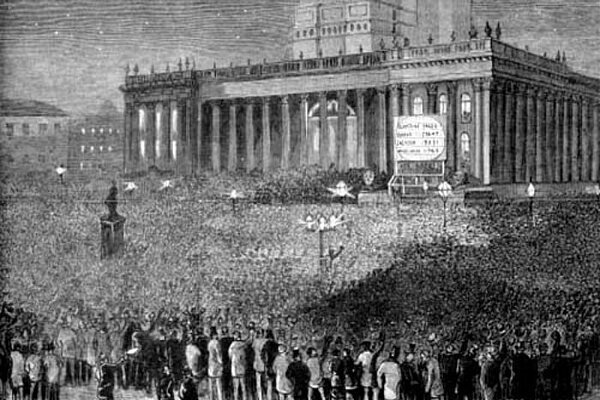
The Liberal governments of 1905-1915, under Sir Henry Campbell-Bannerman and H.H.Asquith, pushed forward reforms including the first national pensions, trade union rights, free school meals, the first labour exchanges, and Trade Boards to regulate wages. Lloyd George’s People’s Budget of 1909 introduced national insurance, against sickness and unemployment, and raised taxes on the wealthiest sections of the community to pay for it. Following a constitutional crisis, when the House of Lords repeatedly rejected the ‘People’s Budget’, two General Elections were held in 1910 in which the Liberal Party was seen to be champions of the people. With the support of Labour and Irish Nationalist members, the Liberals retained a majority in the House of Commons securing the passage of the budget.
Decline and division in the inter-war period
The challenges of the First World War led to the formation of a coalition government in 1915, led initially by Asquith, and then by Lloyd George. Lloyd George won the 1918 general election as head of a coalition of his section of the Liberal Party and the Conservatives. The Independent Liberals, who supported Asquith, won only 27 seats.
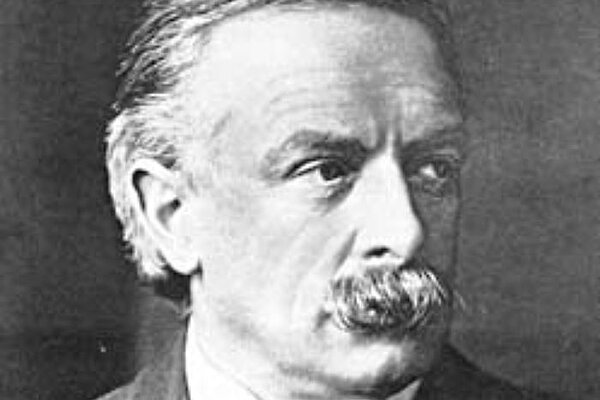
Though the split between supporters of Asquith and Lloyd George was repaired in 1923, the party fell behind Labour to third place in Scotland. The party was further damaged by a split in 1931. However, it continued to show notable intellectual activity, not least in the Liberal Summer Schools held from 1921. Another example was the Industrial Inquiry, chaired by Walter Layton, whose report in 1928 entitled “Britain’s Industrial Future” is better known as The Yellow Book. This formed an important part of the Liberal Party’s programme in the 1929 General Election.
The party provided much of the response to the high unemployment and a depressed economy of the interwar period. The theories of Maynard Keynes, himself a Liberal, became hugely influential and helped secure economic prosperity after the Second World War. Sir William Beveridge, for a short time Liberal MP for Berwick-on-Tweed was the author of a report, Social Insurance and Allied Services, which laid the foundations on which Clement Attlee’s post-war Labour government built the National Health Service and the welfare state.
Post Second World War Revival
The Scottish Liberal Party was established on 15 March 1946 as an independent entity. Jo Grimond, elected MP for Orkney and Shetland in 1950, was UK leader from 1956-1967. He advocated Home Rule for Scotland, industrial democracy and co-ownership, a Highlands and Islands Development Board and regional plans for the North-East and Borders, and liberal reforms in matters of personal status and morality.
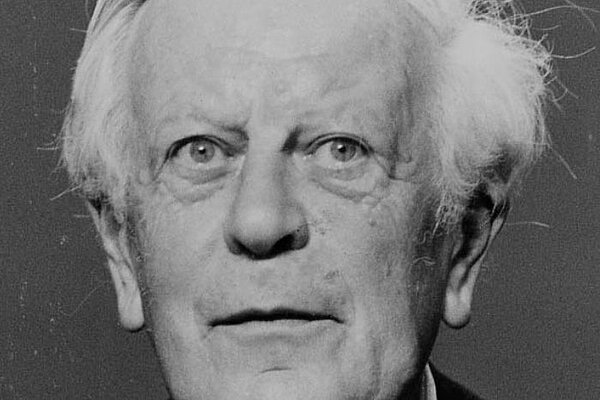
Liberal MPs supported Roy Jenkins, later leader of the SDP, who as Labour Home Secretary decriminalised homosexual acts in England and Wales and abolished the death penalty. The passage of a Bill to liberalise the abortion laws sponsored by David Steel, a recently elected Scottish Liberal MP, was a notable achievement.
The Liberal Party was stoutly internationalist in outlook. Jo Grimond opposed to the ill-fated intervention in Suez. Under his leadership the Liberal Party was the first UK Party to support membership of the European Common Market. The European dimension has been a common strand in Liberalism from Gladstone’s “Concert of Europe” in the 19th century to the Liberal Democrats’ passionate opposition to Brexit in the 21st.
From the 1960s on Liberals increasingly started to contest Council elections under party colours, as befits a Party that believes in the dispersal of power to the most local practical level. The 1970s saw the widespread promotion of “community politics” in the Liberal Party which saw Liberal councillors and candidates campaigning on local issues in their communities and keeping in touch with voters by regular community newsletters.
The Lib-Lab pact and the Alliance
The early 1970s saw renewed support for the Liberal Party, but still with limited success in winning seats. Progress in Scotland was held back by a growth in support for the Scottish National Party. By 1977 James Callaghan’s Labour government had lost its majority in Parliament. David Steel, Liberal leader and a disciple of Jo Grimond’s ideas about the re-alignment of the left, negotiated the Lib-Lab pact with Callaghan, by which the Liberal Party would support the government in confidence votes in return for some changes in policy.
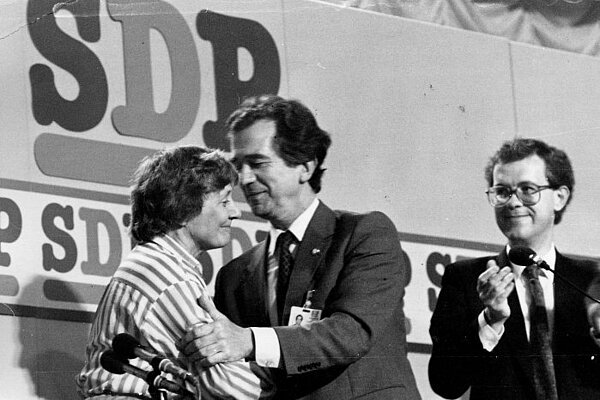
After the election of Margaret Thatcher in 1979, Labour’s social democratic wing became increasingly disenchanted with the leftward drift of the party and saw little future for themselves within it. Four former cabinet ministers – Roy Jenkins, David Owen, Shirley Williams and Bill Rodgers, who became known as the Gang of Four – left the Labour Party to form the Social Democrat Party (SDP). Jenkins was not in Parliament at the time, having served as President of the European Commission, but returned as MP for Glasgow Hillhead in a by-election in 1982 and became first leader of the SDP shortly afterwards. The result in the 1983 General Election was, in votes, the best liberal result since 1923, but the Alliance won just 23 seats, by comparison with 209 for Labour. Eight of the Alliance’s victories were in Scotland. Breaking the mould of British politics was thwarted by the capricious “first-past-the-post” voting system. In the election of 1987, the Alliance’s share of the vote fell to 20% and 22 seats were won, nine of them in Scotland.
The formation of the Scottish Liberal Democrats
After the 1987 election a large majority of members of the Scottish Liberal Party at a special conference voted to enter merger negotiations with the SDP’s Scottish Council, and this was replicated at a Joint Assembly of the Liberal Party south of the border the following week. A majority of members of the SDP was also in favour, but a substantial minority were opposed. The negotiations proceeded more easily in Scotland than elsewhere, with the backing of the SDP’s two Scottish MPs (Bob Maclennan and Charles Kennedy).
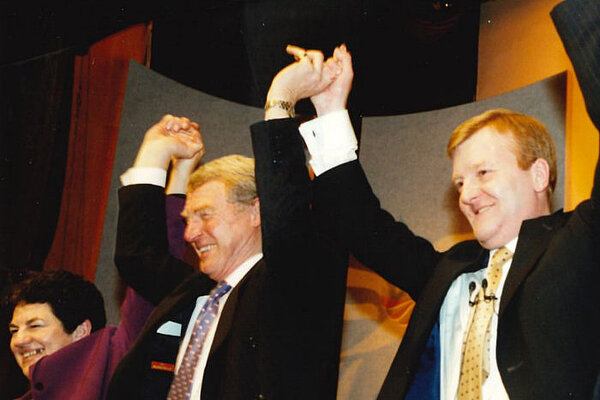
There was agreement at an early stage that the new party should be structured as a Federation of the Scottish Party, the Welsh Party and the Party in England, to mirror the Alliance’s proposals for the governance of the UK. The new Party was launched on 3rd March 1988, with the adherence of 19 MPs and a large majority of the two parties’ Councillors, both in Scotland and elsewhere.
Home rule and Scottish devolution
Liberal support for Home Rule goes back a long way. The name of William Ewart Gladstone, four times Liberal Prime Minister, is often associated with Home Rule for Ireland, the divisive issue in late nineteenth century politics. If the Liberal Unionists had not split with him, his vision might have secured a happier history for Ireland in the twentieth century. He also favoured “Home rule all round”, in which he envisaged both an Irish Parliament and a Scottish Parliament, within the framework of the United Kingdom. A liberal bill for Home Rule for Scotland was in the House of Commons when war was declared in August 1914.
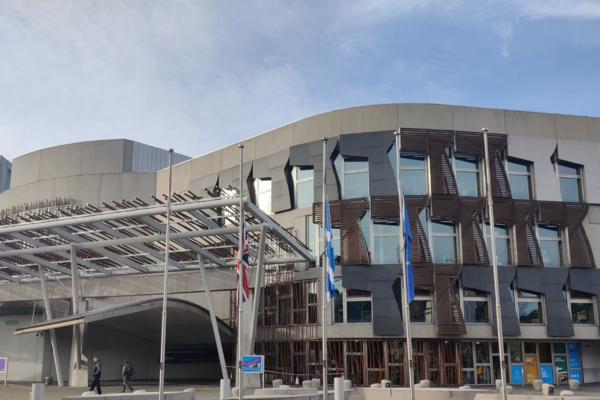
The Scottish Liberals have consistently favoured Home Rule for Scotland. In the 1940s and 1950s the Scottish Liberals backed the Scottish Covenant that called for a Scottish Assembly within the framework of the United Kingdom. The Covenant movement was led by John McCormick, then a leading Scottish Liberal; Jo Grimond was the only Scottish MP to sign it. Russell Johnston, Liberal MP for Inverness for 32 years, introduced a Home Rule Bill on St. Andrew’s Day in 1966. The Liberals were keen supporters of the establishment of the Scottish Assembly proposed by the 1974-79 Labour government, which failed to gain sufficient support in a referendum in 1978. Liberals were active in the Scottish Constitutional Convention which considered the governance of Scotland between 1989 and 1995, and whose conclusions provided the basis for the establishment of the Scottish Parliament in 1999. In particular, it was Liberal influence that secured the agreement that the new Parliament should be elected by proportional voting.
Even in the years after the establishment of the Scottish Parliament the Scottish Liberal Democrats worked hard to increase the powers of the Parliament. The reports of the Smith Commission and Campbell Commission set out proposals for more home rule in Edinburgh and many of the ideas were implemented in the Scotland Act 2012 and Scotland Act 2016.
Liberals in Government at Holyrood and Westminister
17 Liberal Democrats were elected to the new Scottish Parliament in May 1999. Labour won 56 seats, giving a Liberal-Labour coalition an overall majority of 17.
Coalition governments at Westminster have been rare, but were to be expected in a new parliament elected by proportional representation. Jim Wallace, Scottish Liberal Democrat leader had prepared the party well for the possibility of coalition; he became Deputy First Minister and Ross Finnie the Minister for the Environment and Rural Development, was also a member of the cabinet.
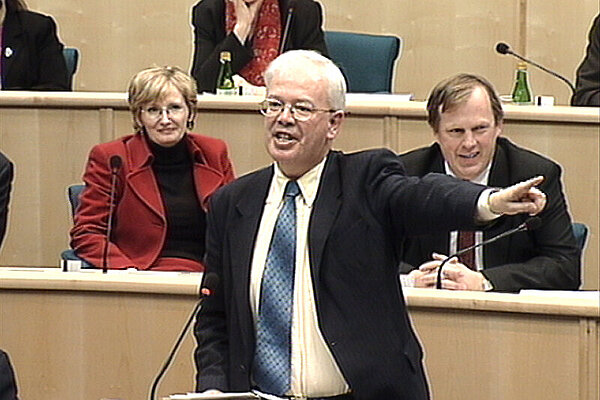
Among the successful policies pressed by Liberal Democrat ministers were the abolition of university tuition fees, free personal care for the elderly and proportional voting for local councils, which has led to less dominance by a single party on councils and more consensual decision making.
Jim Wallace’s proud claim was “It’s the Liberal Democrats who make the difference”. At the 2003 election, the Liberals increased their vote and retained all their seats; Labour won 50 and the coalition continued in Scotland for four more years.
Inspired by the achievements of coalition in Scotland, after the hung parliament in the 2010 UK General election, the party negotiated a coalition between the Conservatives and the Liberal Democrats which saw Liberal Democrat policies implemented across the UK and lasted until 2015.
Though it suffered in popular esteem from the financial stringency that followed the financial crisis of 2008, the coalition adopted the Liberal Democrat policy of substantially raising personal allowance and thus reducing the tax burden on income tax payers of limited means. The years since 2015 have shown that coalitions can deliver stable government where the influence of the extremes of politics – then from the Conservative right wing – can be kept at bay.
Both 1999-2007 in Holyrood and 2010-2015 at Westminster demonstrated that Liberal Democrats can aspire to government office and work with others to put their principles and policies into effect
Survival and Recovery
The morning after the 2015 general election, Nick Clegg resigned as leader of the party, being replaced by Tim Farron. Despite the brutal election result, there were reasons to hope: the party saw an immediate surge in membership, as many people perceived that liberal values were under threat and that the party had been punished unfairly for participation in coalition.
The 2016 Scottish Election, under the leadership of Willie Rennie, saw the party win back the constituencies of Edinburgh Western and North East Fife. This represented a key step on the road to recovery after all mainland constituencies had been lost in 2011. The party also gained 3 Scottish Westminster constituencies in the 2017 General Election.
The Liberal Democrats campaigned strongly for a ‘remain’ vote in the referendum on Britain’s membership of the EU in June 2016, in line with their historic beliefs. The narrow vote to leave, Farron’s unequivocal statement, two days later, that the Liberal Democrats would fight the next election on the basis that the UK would be better off inside the EU, and his later call for a referendum on the final deal, gave hope to defeated remain voters and led to another surge in party membership.
Two years of parliamentary stalemate over the terms of the Brexit deal led to a growing polarisation in the electorate, and the Liberal Democrats, fighting on a platform of ‘stop Brexit’, surged to an unexpected second place in the Euro elections in May 2019, ahead of both Labour and the Conservatives. The party also attracted several defecting MPs from both other main parties.
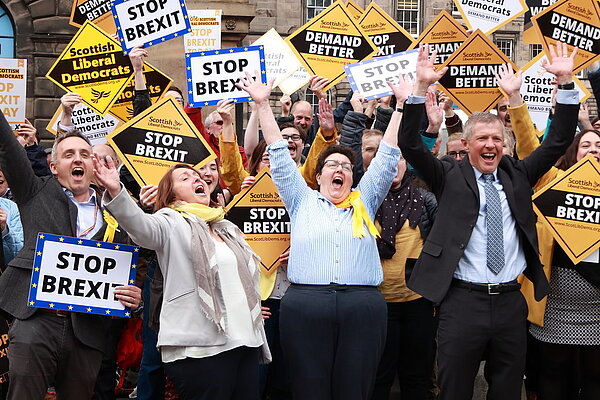
At the 2019 General Election, although the party secured a increase in its vote share, polling 9.5% in Scotland, the overall result saw a Conservative majority and large gains for the SNP across Scotland. The Westminster constituency of North East Fife was regained from the SNP, after coming within 2 votes of doing so in 2017, although party leader Jo Swinson lost her East Dunbartonshire to the SNP by just 149 votes.
In 2020 Ed Davey thus became the party’s next UK leader. He faced familiar problems in gaining media attention and recognition as head of the small fourth party at Westminster but the party’s organisation and campaigning capacity was comprehensively overhauled, efforts which paid off in local and parliamentary by-election successes as a succession of disastrous Conservative Prime Ministers comprehensively undermined support for their government.
In 2021, Willie Rennie stepped down as a Scottish Liberal Democrat leader. After 10 years at the helm he had ensured the party's survival and led the party to building strongholds in its constituencies at the 2021 Scottish election with records broken for total votes received by a constituency candidate. Alex Cole-Hamilton became the next leader of the Scottish Liberal Democrats.
The 2022 Council Elections the following year saw the Scottish Liberal Democrats record its first increase in councillors since 2003. A gain of 20 new councillors represented the joint strongest performance by any opposition in the local elections. This led to Alex Cole-Hamilton announcing an ambitious target of 150 seats at the next local elections in 2027.
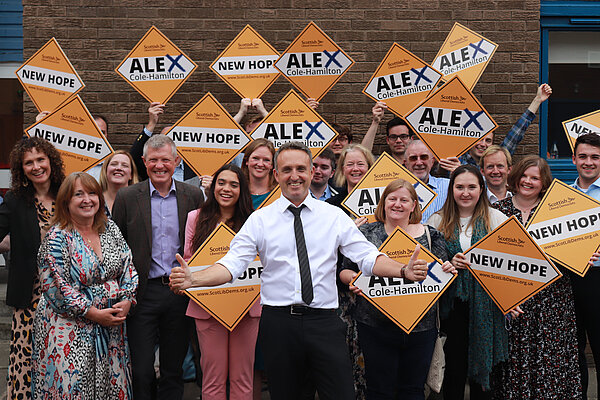
The outcome of the 2024 General Election was extraordinary as the collapse in the Conservative and SNP vote shares led to a landmark result for the party in Scotland and across the UK. 72 MPs at Westminster represented the best performance for the party in 100 years, and meant the SNP had been overhauled as the third party at Westminster for the first time since 2015.
In Scotland the party trebled its seats from 2 notional holds to 6 constituencies, holding Orkney and Shetland and Edinburgh West, overturning notional deficits in North East Fife and Caithness, Sutherland and Easter Ross, as well as regaining Mid Dunbartonshire (previously East) and regaining the seat once held by Charles Kennedy: Inverness, Skye and West Ross-shire. The final result was especially meaningful for the party and marked an important stage of the party's recovery by winning back an area it had not held since the coalition.
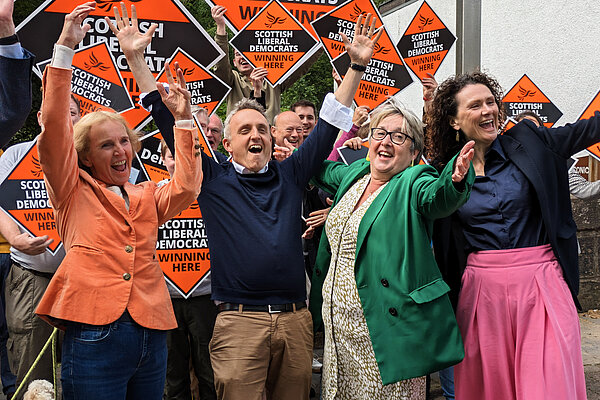
The 2026 Scottish Election represented a surge forward for the party, and the culmination of the process of recovery of over a decade. The party more than doubled its MSP group, returning 10 MSPs, including 3 regional list MSPs, the first elected by the party since 2016.
The party broke new ground in winning the constituencies of Strathkelvin and Bearsden and Edinburgh Northern, neither of which had ever been won by the Scottish Liberal Democrats before. The party also overturned the 3rd safest seat in the country with its victory in Skye, Lochaber and Badenoch, the seat of the former Deputy First Minister Kate Forbes.
An impressively strong result of 23.6% on the Highlands and Islands regional list saw the party gain its 10th MSP after a delayed count at 1am to complete its cohort.
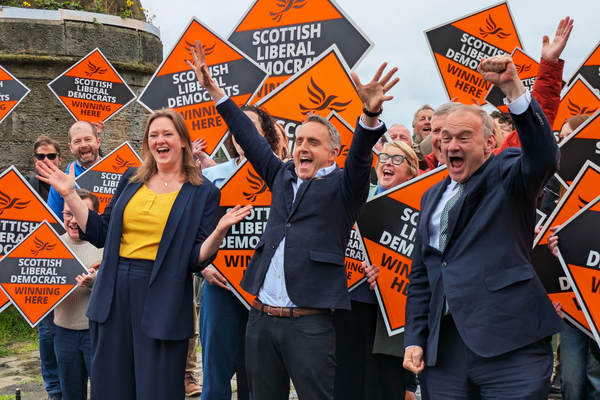
With the arrival of Reform and the increase in vote of the Scottish Greens, as well as the collapse in support for the SNP, Scottish politics is entering a new era. The new composition of the Scottish Parliament leaves the Scottish Liberal Democrats in a strong position to wield influence and make a difference to Scotland's future.